
Yo-Yo Graph
PUFA by Dead Reckoning

Since there’ve been a couple of obvious turning points in my seven-day average weight I’ve got an updated graph.
The entire list of significant turning points is this:
keto_water_weight=1.5
readings = [
(”2023-05-22”, 99),
(”2023-09-14”, 92+keto_water_weight),
(”2023-10-13”, 95.46),
(”2023-11-11”, 91.6+keto_water_weight),
(”2024-04-05”, 97.44),
(”2024-05-05”, 95.50),
(”2024-08-28”, 97.16),
(”2024-09-22”, 94.88+keto_water_weight),
(”2024-10-06”, 96.6),
(”2024-11-03”, 93.4+keto_water_weight),
(”2024-12-29”, 96.6),
(”2025-01-14”, 94.07),
(”2025-03-28”, 96.94),
(”2025-07-01”, 92.37),
(”2025-09-15”, 96.2),
(”2025-11-23”, 91.2+keto_water_weight),
(”2026-01-12”, 99.18),
(”2026-02-09”, 96.41),
]
With the last one, which isn’t a turning point, provisional, just the latest seven-day average.
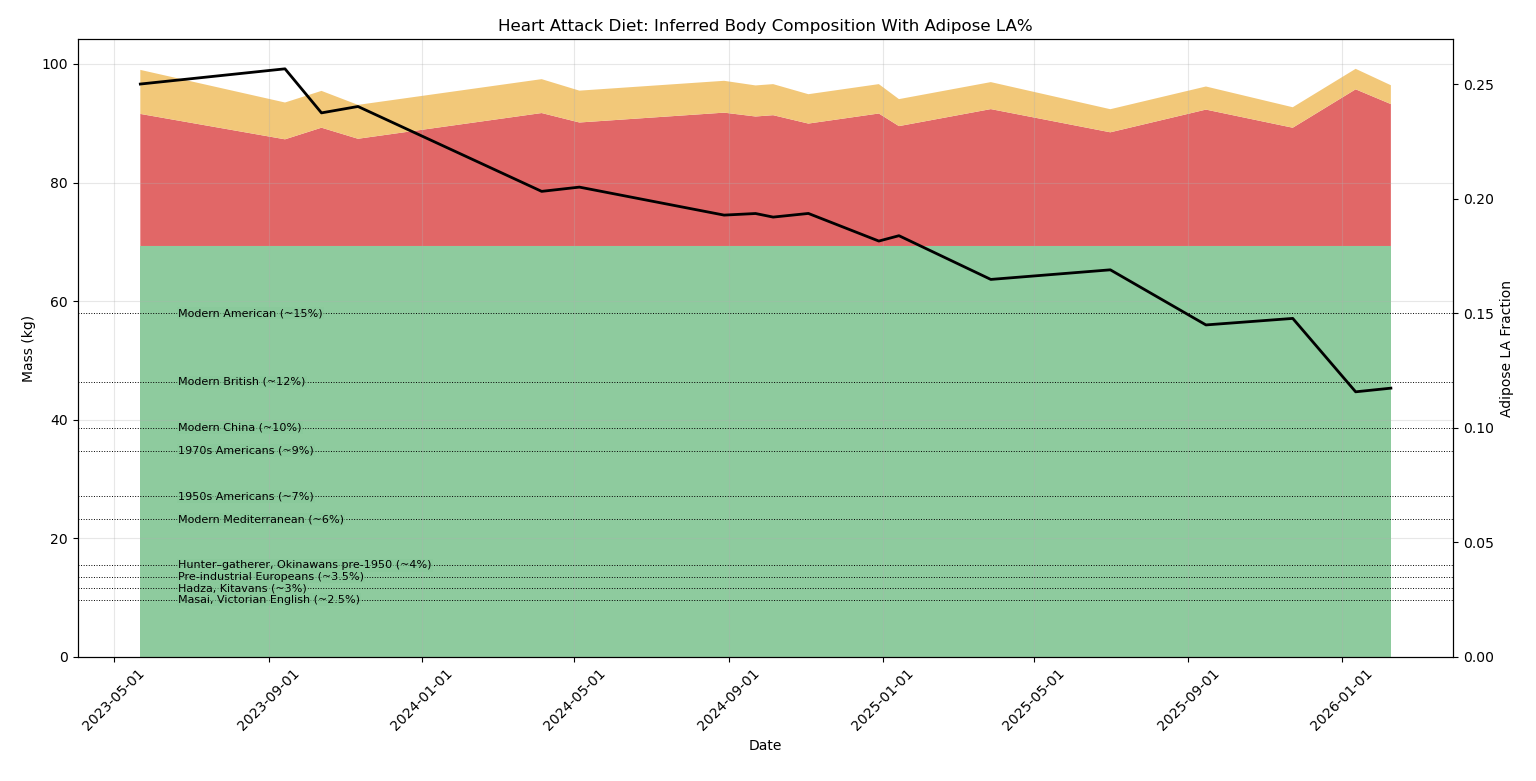
In this graph, green is non-fat mass, red is normal body fat, and yellow is PUFA, with the scale on the right in kg. The black line is the fraction of total fat which is PUFA, scale on the right with some illustrative lines for various populations where we know or can guess the percentage.
You can see that my recent huge weight yo-yo has made a big difference to the (inferred) PUFA fraction. From about 15% to about 12% over a couple of months.
This graph is based on some pretty pessimistic assumptions, PUFA-wise, such as that I started at 25%, that just eating an almost no-PUFA diet doesn’t actually cause depletion in itself1, and that when I lose weight I lose normal fat faster than PUFA2, so that the percentage actually rises.
There is also the rather optimistic assumption that because I’m never doing anything other than eating ad-lib, and so never causing my body to think that resources are scarce and going into starvation-mode, my weight loss periods don’t involve losing significant non-fat mass.
So if the optimistic assumption is true, then my current guess at PUFA making up 11% of body fat is kind of an upper limit on what must have been happening, and I imagine that the true situation is at least slightly better than that.
I infer that I’m probably now below the reported modern British average PUFA content of 12%.
64% of modern British adults are overweight (BMI>25), and 26% of us are obese (BMI>30).
At 95.2kg and 5’10” (~178 cm), my current BMI is:
$ python3 -c ‘print((95.2)/ ((5*12+10)*0.0254)**2)’
30.1143459429776
I’m roughly on the boundary between overweight and obese, although since my ‘happy BMI’ was 27 at my once normal weight of 85kg3, I’m probably not as overweight as my raw weight/height makes it look. I’m not unhappy at 95.2kg, and down at 92kg I stop noticing that I’m fat at all. It got to 93kg before I even realised that I was putting on weight.
So that all looks kind of plausible so far, I guess.
Three years ago my weight was stable at 99kg4, now it seems to be stable somewhere below 95kg5.
My predictions are that short-term I will continue to lose weight ‘naturally’, that is without doing anything in particular to cause that to happen, and that long term, further yo-yos will reduce the amount of PUFA that I’m carrying, and if PUFAs do cause obesity and lack-of-PUFAs can fix it, then that should start to take me back in time, weight-wise. It does so far seem to be doing exactly that.
The next target is modern China’s level of 10% and just below that the level of Americans in the 1970s, who weren’t yet notably fat as I remember, although they were starting to be. Still a long way to go to get down to more natural levels.
Because there’s a bit of PUFA in everything, and we don’t need much at all.
Opinions seem divided here, some claim that PUFA is preferentially released from fat cells, but there are also claims that it’s hard to burn. If it doesn’t get burned it will get stored again, so I’ve decided to go for the weakest claim, that weight loss actually increases your percentage PUFA (although it drops your total PUFA, because some of it gets burned)
I’m heavy built, I was 85kg from age 25 to age 40 and it never moved significantly and it suited me. I don’t look fat in old photos, I look like the fanatical rower I once was.
My stable weight eating ad-lib had been rising continuously at about 1kg/quarter for about a year and a half. It was 99kg at the point where I stopped eating peanut butter, which was the last thing I ate that contained significant PUFA, and started measuring my weight daily.
I claim. I came back from Mum’s really very overweight, again at 99kg, and since then I’ve had very little appetite, and it’s falling fast. I think there’s further to fall.
Is it the general theory that your diet alters the lipid content of the membranes of your cells making them more insulin sensitive (a good thing) and your weight changes are a proxy for insulin response?